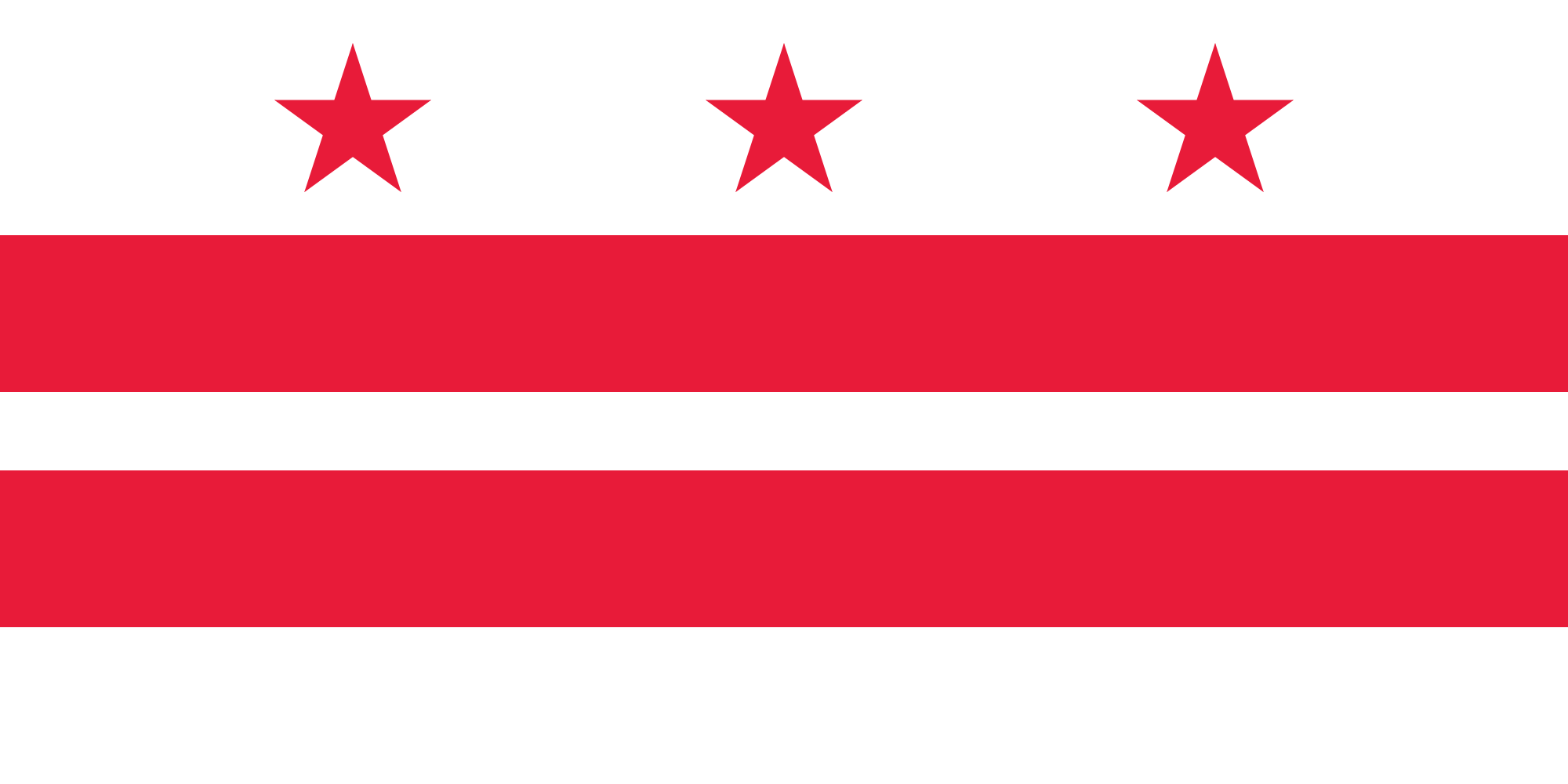
The District of Columbia uses three red five-pointed stars above two red horizontal bars on a white field, adapted from the Washington family arms.
Design structure
The design is almost entirely heraldic geometry: three equally spaced stars occupy the upper white field, with two solid red bars below. In heraldry the stars are properly called mullets.
Display color
HEX #E21C2A / screen reconstructionHeraldic origin
The stars and bars come from the coat of arms associated with George Washington’s family. The stripped-back flag translates that shield into a civic symbol without lettering or a seal.
Historical record
The District formally approved the flag on 25 October 1938. It has remained visually stable and is widely used both as a government flag and as an informal symbol of the city.
Source trail
Government of the District of Columbia: DC Symbols ↗
The official account confirms the approval date, device count, colors, and Washington-family origin.
Specification and reconstruction limits
The supplied source trail attributes four points to the D.C. government’s account: approval on 25 October 1938; three stars and two bars; red devices on a white field; and an origin in the Washington family arms.
The record describes 1:2 as a common format, rather than an officially established proportion in the supplied evidence. The specimen’s precise display geometry is reconstructed. Its existing red value, #E21C2A, is a screen approximation, not an official manufacturing color standard. The specimen should therefore not be treated as a certified construction specification.
Frequently Asked Questions
What do the stars and bars on the D.C. flag represent?
The design derives from the coat of arms associated with George Washington’s family. It has three red five-pointed stars above two red horizontal bars on a white field. In this design, “mullets” means five-pointed stars. The supplied evidence establishes the heraldic origin but does not assign separate meanings to individual stars or bars.
What does the common 1:2 ratio mean?
The ratio describes height to width: the flag is twice as wide as it is high. For example, a flag 1 unit high would be 2 units wide. The record calls this a common format; the supplied source trail does not establish it as an official requirement or certify the specimen’s precise geometry.