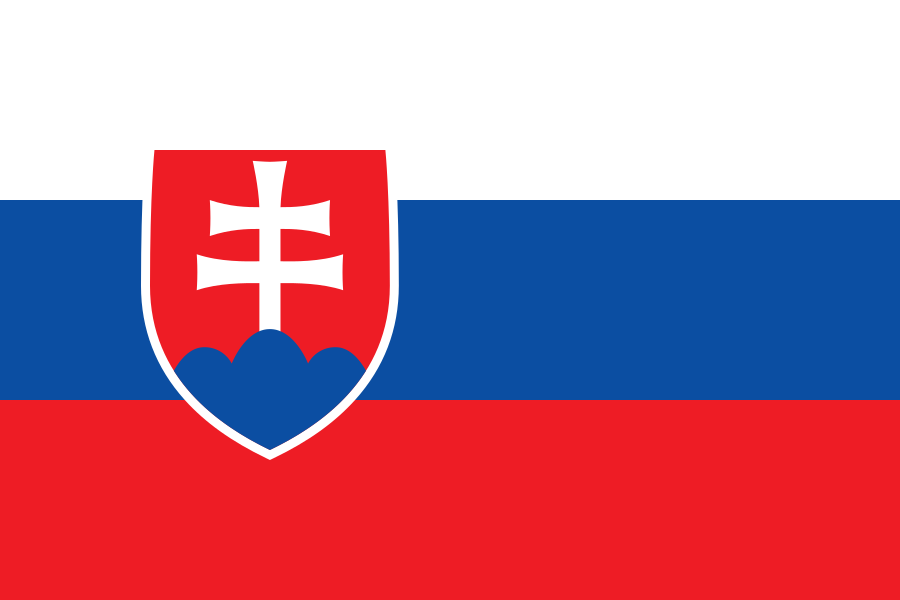
Slovakia’s current national flag is a white-blue-red horizontal tricolor carrying the national arms toward the hoist. Its rectangular format is 2:3.
Specification
Constitution Article 9 identifies the three colors and the arms on the hoist half. The Presidency describes the arms as a silver double cross on the raised middle of three rounded blue hills, within a red Early Gothic shield. The cross ends widen and curve inward; white may replace silver under the state-symbols act.
Specimen screen colors
#FFFFFF / specimen only#0B4EA2 / specimen only#EE1C25 / specimen onlyThese values are extracted from the SVG. No physical color standard, Pantone/RAL match, or manufacturing tolerance was independently verified; named legal colors must not be replaced by assumed screen equivalences.
Construction notes
The Government Office reproduces the statutory rules: equal horizontal thirds, arms equally distant from the top, hoist and bottom, and white edging where the shield meets a non-white field. There is no additional contour line.
For a 900 × 600 reference frame, the rules imply 200-unit bands, a 300-unit shield height and 150-unit clearances before edging. The required edging is 9 units. The inspected SVG has shield bounds approximately x=150–389.839 and y=150–450; its white backing reaches x=141 and the bottom approximately y=459.989. The pointed join extends beyond the nominal edging distance. Curves use rounded coordinates; these are specimen measurements, not legal tolerances. Use the official model for production.
The štátna zástava is a separately regulated, fixed-pole or crossbar form. Section 10 permits length up to three times width; that provision does not change the 2:3 flag specified here.
Symbols and usage
The Government Office identifies white, blue and red as Pan-Slavic colors and traces the flag tradition to 1848. The cross and hills belong to the national arms; the cited legal texts describe their form without assigning separate meanings to each stripe.
Sections 8 and 11 provide for official-building and holiday display and allow dignified use by individuals and legal entities. Added inscriptions or ornaments and damaged or soiled flags are prohibited; mourning display is at half-mast.
Historical record
The Constitution adopted on 1 September 1992 established the arms-bearing design. Parliament’s historical account dates its first ceremonial hoisting at Bratislava Castle to 3 September 1992. This is distinct from the Constitution’s proclamation on 1 October 1992.
The Government Office describes official introduction as 1 January 1993, the beginning of independent-state use. This record therefore distinguishes constitutional adoption, first hoisting and independent-state use instead of collapsing them into one date. The detailed state-symbols act was adopted on 18 February 1993 and promulgated, taking effect, on 22 March 1993. The earlier plain tricolor is not the current specimen.
Source trail
Slov-Lex: original Constitution, Article 9 and legislative dates ↗
Slov-Lex: Act 63/1993, consolidated version effective 24 May 2019; §§2, 7–11, 16 and Annex 2 ↗
Government Office: flag, construction rules and official downloads ↗
Presidency: symbols and geometry ↗
National Council: first ceremonial hoisting ↗
Specimen source, rights, hash and geometry audit →
Related records: Czechia · Poland · National flags
Understanding the measurements
Hoist means the flag’s vertical height; fly means its horizontal length. A hoist:fly ratio of 2:3 means two units high by three units long. The existing 900 × 600 example lists width before height: 900 drawing units long and 600 drawing units high, giving the same 2:3 ratio. These are drawing units, not a prescribed physical size. The statutory geometry and the inspected SVG’s specimen measurements remain distinct: rounded coordinates and the white backing’s pointed join are not legal manufacturing tolerances. See the specimen provenance and geometry audit.
Frequently Asked Questions
Why does this record give both 1992 and 1993 dates?
The dates describe different milestones. The Constitution adopted on 1 September 1992 established the arms-bearing design. Parliament’s historical account records the first ceremonial hoisting at Bratislava Castle on 3 September 1992. The Government Office gives 1 January 1993 as the official introduction, marking independent-state use. Constitutional adoption, first ceremonial hoisting and independent-state use are therefore recorded separately.
Are the hexadecimal colors official manufacturing specifications?
No. White #FFFFFF, blue #0B4EA2 and red #EE1C25 are screen values extracted from the supplied SVG specimen only. They are not verified physical color equivalents or manufacturing specifications. No physical color standard, Pantone/RAL match or manufacturing tolerance was independently verified for this record; the legally named colors must not be replaced by assumed screen equivalences. The specimen is a digital rendition, not a certified manufacturing master. Its existing contributor credits, rights declaration and geometry audit are retained in the specimen provenance.