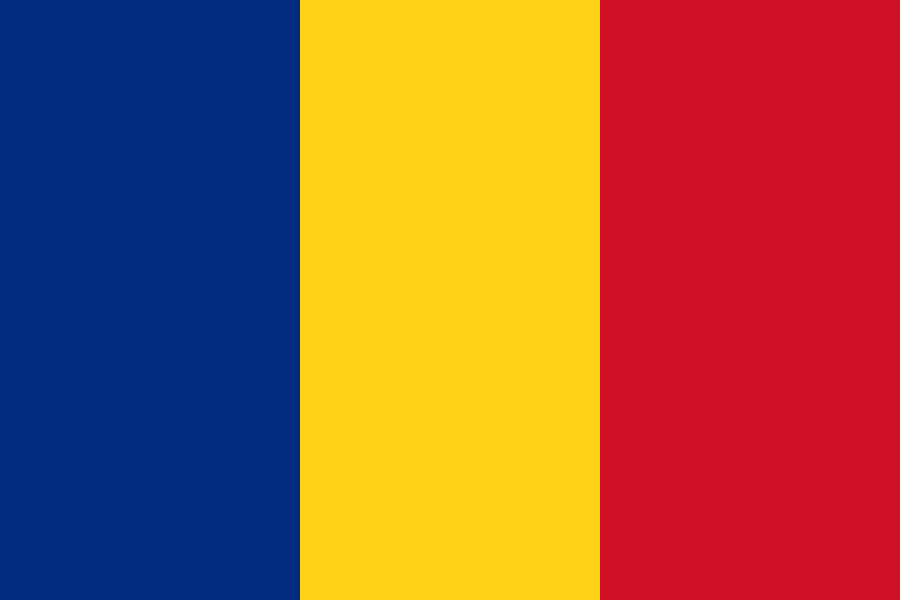
Romania’s national flag is a vertical tricolor of three equal bands: blue at the hoist, yellow in the center, and red at the fly.
Specification
Article 12 of the Constitution sets the hoist-to-fly order as blue, yellow, and red. Law 75/1994 defines a rectangle whose height is two-thirds of its length and divides that length into three equal color bands. Its color annex was updated in 2023 with print and screen values.
Official colors
Pantone 280 C / RGB 0, 43, 127Pantone 116 C / RGB 252, 209, 22Pantone 186 C / RGB 206, 17, 38Construction notes
Construct a 2:3 rectangle and divide its length into three equal vertical areas. Blue meets the staff, followed by yellow and red. The civil national flag carries no charge; legislation bars additional inscriptions or symbols unless separately authorized.
Historical record
Romania’s national tricolor tradition is traced to the revolutionary decree of June 1848. The vertical arrangement with blue at the staff was established during the nineteenth century and continued through later state forms, sometimes bearing official arms. The 1991 Constitution confirms the plain blue-yellow-red tricolor, while Law 75/1994 supplies its production geometry.
Source trail
Romanian Constitution, Article 12 ↗
Romanian Legislative Portal: Law 75/1994, consolidated text and color annex ↗
Romanian Ministry of National Defence: history of the tricolor ↗
Understanding the flag’s geometry
The hoist is the edge next to the flagpole; the fly is the opposite edge. The ratio 2:3 describes height relative to length: the flag is two units high for every three units long. Three equal vertical bands run from top to bottom, each occupying one-third of the length. From the pole toward the fly, their order is blue, yellow, red. Article 12 of the Constitution specifies the color order, while Law 75/1994 supplies the proportions and equal-band geometry.
| Band color | Pantone reference | RGB red | RGB green | RGB blue |
|---|---|---|---|---|
| Blue | 280 C | 0 | 43 | 127 |
| Yellow | 116 C | 252 | 209 | 22 |
| Red | 186 C | 206 | 17 | 38 |
Color specifications and the illustration
The table makes the Pantone references and RGB values cited in the imported record accessible as text. That record attributes the specifications to the color annex of Law 75/1994, updated in 2023. Pantone references and RGB screen values serve different reproduction contexts; they should not be treated as a guarantee that a displayed color matches manufactured fabric.
The retained illustration is a geometric display rendering of the flag and its 2:3 proportions. Its on-screen appearance is an approximation, not certification of fabric colors. Neither the illustration nor this table establishes manufacturing tolerances or documents customary manufacturing practice.
Frequently Asked Questions
What does 1991 signify for Romania’s flag?
1991 identifies the constitutional confirmation of the plain blue-yellow-red tricolor. The record therefore labels it “Constitutional form: 1991”; it does not present that year as the flag’s first adoption.
How does 1991 differ from the tricolor’s earlier history?
The supplied historical account traces Romania’s national tricolor tradition to the revolutionary decree of June 1848. That earlier tradition and the constitutional confirmation in 1991 are distinct milestones, rather than interchangeable adoption dates.
What do Law 75/1994 and the stated 2023 update add?
Law 75/1994 supplies the production geometry: a rectangle with height two-thirds of its length and three equal vertical bands. The imported account states that its color annex was updated in 2023 with print and screen values. These specification milestones are distinct from both the tradition traced to June 1848 and constitutional confirmation in 1991.