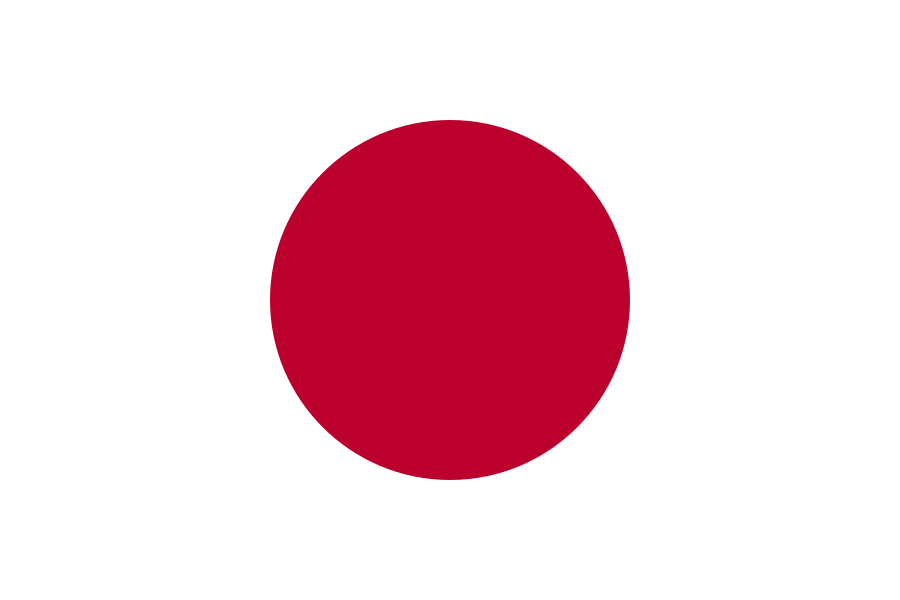
Japan’s national flag is a white 2:3 rectangle bearing a centered crimson disc whose diameter is three-fifths of the flag’s hoist.
Specification
The construction is governed by the Act on National Flag and Anthem of 1999. The sun disc is placed at the exact center of the white field, giving the flag a compact geometric definition.
Reference colors
HEX #BC002D / common screen referenceHEX #FFFFFF / RGB 255, 255, 255Construction notes
Draw a rectangle three units wide and two units high. Locate the intersection of its diagonals, then draw a circle centered there with a diameter equal to 60% of the hoist. The statutory color is described as a deep red; digital equivalents should be labelled as reproductions unless tied to an authoritative color system.
Historical record
The sun-disc design has a much longer history than the 1999 act. It was used as a national emblem and ensign before the modern statute formally established the Nisshōki as Japan’s national flag.
Source trail
This starter record follows the construction schedule attached to Japan’s Act on National Flag and Anthem. Document links and translation notes will be added during the citation pass.
Statutory specification and translation notes
The Act on National Flag and Anthem (国旗及び国歌に関する法律, Act No. 127 of 1999), Article 1, identifies the Nisshōki as Japan’s national flag and refers its construction to Appended Schedule 1 (別記第一). The Cabinet Office reproduces the Japanese article and schedule: height is two-thirds of width, the disc diameter is three-fifths of height, and the disc shares the flag’s center. Japanese statutory text and schedule.
Schedule 1, item 2, specifies 白色 for the field and 紅色 for the disc. These are rendered here as white and crimson; the Cabinet Office’s own English summary uses “white” and “deep red.” This prose is an editorial summary of the Japanese text, with color terminology cross-checked against that government English summary, rather than a quotation from an official English translation of the Act. Cabinet Office English explanation.
The 1999 legislation formalized an existing flag tradition. A government answer dated 11 June 1999 describes the Hinomaru’s established customary use before the Act; 1999 therefore denotes statutory establishment, not the design’s origin. Government answer, sections 一の3 and 一の11.
Screen colors and production specifications
Both displayed values—crimson #BC002D and white #FFFFFF—are screen representations used in this record. Neither is a hexadecimal specification in Appended Schedule 1, which names the colors in words. These display values do not establish a customary manufacturing standard or certify textile, ink or print matches. No independently documented manufacturing color standard is supplied here. Statutory color wording, Schedule 1, item 2.
Worked construction example
Hoist means the flag’s height; fly means its width. For the schedule’s 2:3 construction, choose a height of 100 units. The width is 100 × 3/2 = 150 units, and the disc diameter is 100 × 3/5 = 60 units. Place the disc’s center 150/2 = 75 units from either vertical edge and 100/2 = 50 units from either horizontal edge. These are calculated dimensions for an illustrative scale, not additional statutory measurements. Construction basis: Appended Schedule 1, item 1.
Verified supporting sources
- Cabinet Office: Japanese text of Act No. 127 of 1999, Article 1 and Appended Schedule 1. Primary evidence for designation, geometry and color wording; this page omits the supplementary provisions.
- Cabinet Office: National Flag & National Anthem. Government English explanation of the August 1999 legislation, geometry, and colors; uses “deep red” for the disc.
- Government answer to Representative Kazuo Ishigaki, 11 June 1999, answer No. 31. Sections 一の3 and 一の11 document recognition and use before the statute; Japanese original.