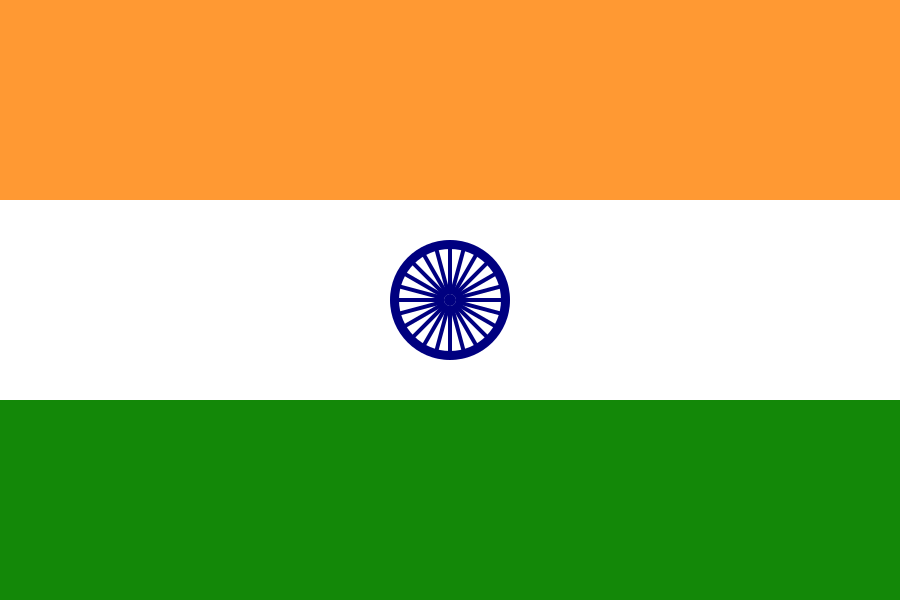
India’s flag has three equal horizontal panels: India saffron, white, and India green. A navy-blue Ashoka Chakra with 24 equally spaced spokes is centered in the white panel.
Specification
The flag is rectangular, with its length one and a half times its height. Each color panel occupies one third of the height. The Chakra is centered in the middle panel and must be completely visible on both faces of the flag.
Display colors
Screen approximation / HEX #FF9933HEX #FFFFFFScreen approximation / HEX #138808Screen approximation / HEX #000080Construction notes
The Chakra is a specific 24-spoke wheel rather than a plain disc or decorative rosette. For formal production, the Flag Code and the applicable Bureau of Indian Standards specification take precedence over screen color values and simplified digital artwork.
Historical record
The Constituent Assembly adopted the flag on 22 July 1947, shortly before independence. The design developed from an earlier tricolour, replacing its central device with the Ashoka Chakra.
Source trail
Ministry of Home Affairs: Flag Code of India, 2002 ↗
Ministry of Home Affairs: National Flag, Emblem and Anthem documents ↗
Horizontal panels and symmetry
The preserved reference section’s “Symmetry / Horizontal” card is ambiguous. Horizontal describes the direction of the bands; it does not establish reflection symmetry. Reflecting the full flag across a horizontal axis through its centre would exchange the saffron and green panels, so the full coloured flag does not have horizontal reflection symmetry.
A vertical axis through the flag’s centre would preserve the arrangement of the three bands; symmetry of the complete design about that axis also depends on the Chakra’s geometry. Any symmetry statement about the Chakra alone must identify the axis through its centre, or the rotation being considered, and applies only to the wheel, not automatically to the full flag. No exact symmetry of the supplied digital artwork is certified here.
Reference artwork and screen colours
The official specifications described in the imported record and the local digital rendering are distinct. The displayed HEX values—saffron #FF9933, white #FFFFFF, green #138808 and navy blue #000080—are screen representations, not verified physical colour standards or manufacturing tolerances. The reference rendering is not established here as artwork certified for manufacture, and customary manufacturing practice is not independently verified.
The supplied asset record for src/assets/flags/india.svg does not document its creator, source or license: its credit, source URL and license fields are empty. The existing asset and provenance are preserved; these missing details do not establish permission to reuse the artwork. The imported caption’s reference to the Flag Code does not itself document the digital artwork’s origin or certify conformity.
How to read the source trail
The two existing citations are imported source links attached to the preserved reference section. Their locator text records that they were preserved from legacy content; it does not identify passages supporting individual claims. The bibliography distinguishes the linked Ministry of Home Affairs PDF from the Ministry’s document index. An index helps locate documents but is not itself a claim-specific locator.
The summary and structured metadata restate information already present in this record. “Adopted 22 July 1947” records an adoption date, not an independently verified service period. No new precise citations for dimensions, adoption or manufacturing requirements are added here: relevant passages must be verified before such locators are supplied. The review-date field remains unset.
Bibliography
- Ministry of Home Affairs — linked PDF (FlagAdvisoryEng_06082021_0.pdf), labelled “Flag Code of India, 2002” in the imported record; claim-specific passages not verified here.
- Ministry of Home Affairs — National Flag, Emblem and Anthem document index; a document discovery page rather than a passage-specific citation.