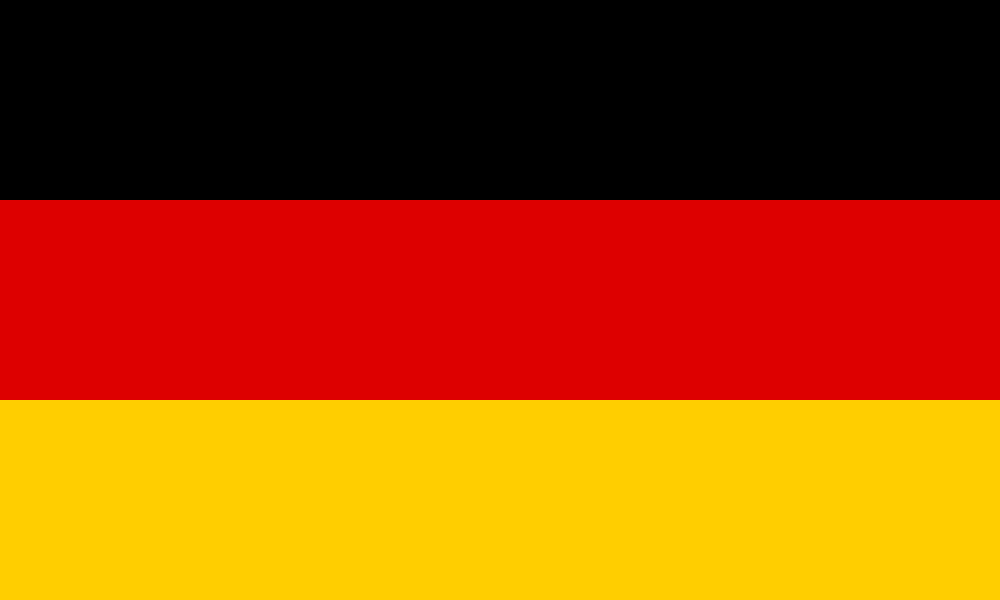
Germany’s federal flag is a 3:5 horizontal tricolor of three equal bands: black above red above gold.
Specification
The federal flag order defines three equally wide horizontal stripes, black above red above gold, in a height-to-length ratio of 3:5. The plain tricolor is distinct from federal service flags that add an emblem.
Display colors
HEX #000000 / asset screen valueHEX #DD0000 / asset screen valueHEX #FFCE00 / asset screen valueConstruction notes
Start with a 3-by-5 rectangle and divide its height into thirds. The order is invariant: black at the upper edge, red through the center, and gold at the lower edge. The law names colors rather than hexadecimal values, so the screen values above describe this reference asset rather than a statutory digital palette.
Historical record
Black, red, and gold became associated with German unity and constitutional government in the nineteenth century. The Parliamentary Council restored them as the federal colors in Article 22 of the Basic Law on 23 May 1949. Reunified Germany continued the tricolor in 1990; the current federal flag order dates from 1996.
Source trail
Federal Ministry of Justice: Order concerning the German flags ↗
Understanding the two dates
The supplied record’s two dates mark different events. 23 May 1949 refers to the restoration of black, red and gold as the federal colors in Article 22 of the Basic Law. Germany continued the tricolor after reunification in 1990. 13 November 1996 is the date of the later federal flag order, which specifies three equal horizontal bands and a 3:5 height-to-length ratio. The 1996 date is therefore not presented as the origin of the tricolor.