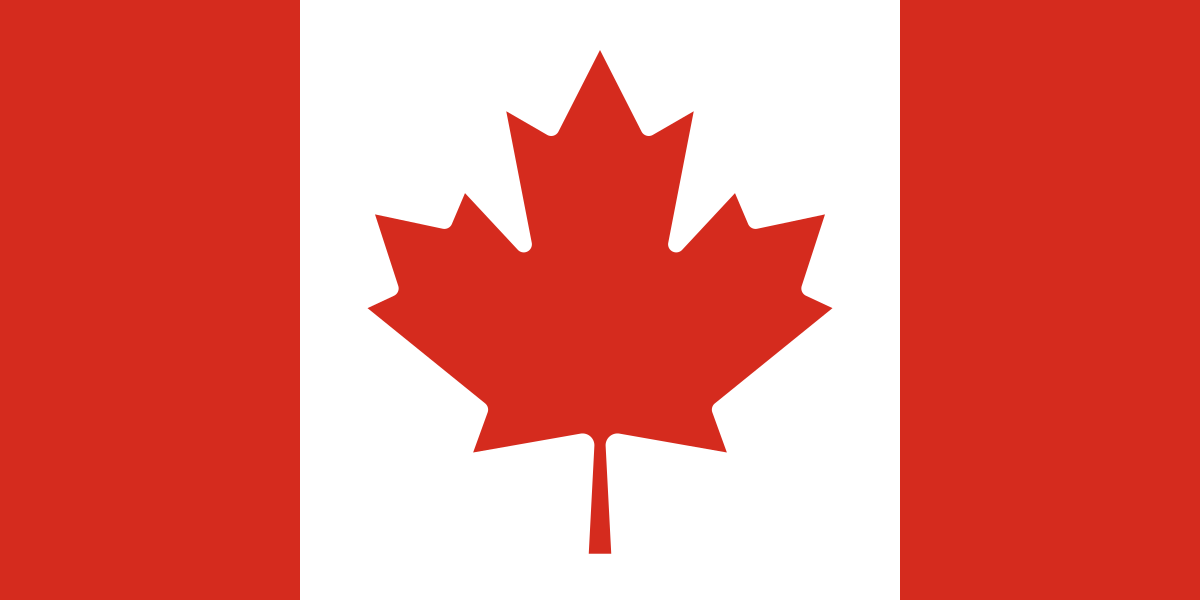
Canada’s flag is twice as long as it is high. Its center is a white square, flanked by red rectangles, with a stylized eleven-point maple leaf at the center.
Specification
The official description is “Gules on a Canadian pale Argent a maple leaf Gules.” In geometric terms, a 64-by-32-unit flag divides into red fields of 16 units, a central white square of 32 units, and another 16-unit red field.
Reference colors
Screen approximation shown; production standards vary by useHEX #FFFFFF / RGB 255, 255, 255Construction notes
The outer red panels are each half the width of the central white square. The maple leaf is a protected, specific drawing—not an interchangeable botanical silhouette. Production files should use the official artwork supplied by the Government of Canada.
Historical record
Parliament approved the design in 1964. A royal proclamation followed on 28 January 1965, and the flag was raised for the first time on Parliament Hill on 15 February 1965.
Source trail
Canadian Heritage: Description of the National Flag of Canada ↗
The Government of Canada also maintains separate manufacturing standards for outdoor, indoor, and one-event-only flags.
Understanding symmetry and orientation
The preserved specification’s label “Symmetry: Horizontal” describes left–right mirror symmetry about the vertical centreline: the two sides match when reflected across a line from top to bottom through the leaf. It does not mean top–bottom symmetry; the upright leaf and its downward stem distinguish the top from the bottom.
Here, hoist means height and fly means length. The ratio 1:2 (hoist:fly) therefore means that the flag is twice as long as it is high. See the Canadian Heritage technical description.
Reading the construction measurements
The imported 64-by-32 example uses scalable units, not a required physical size. Multiply every measurement by the same factor to preserve the proportions. Across the flag, the left red panel, central white square and right red panel divide its length in the ratio 1:2:1.
For a plain-language description of the preserved illustration: a red eleven-point maple leaf stands upright in the centre of a white square, with a red rectangular panel on either side.
| Element | Width (units) | Height (units) |
|---|---|---|
| Whole flag | 64 | 32 |
| Left red panel | 16 | 32 |
| Central white square | 32 | 32 |
| Right red panel | 16 | 32 |
Screen swatches and production colours
The imported screen swatches use #D80621 for red and #FFFFFF for white. These are display values, not certified manufacturing specifications or verified fills in the preserved SVG artwork. The imported “Pantone asset” caption does not establish a complete production colour standard or demonstrate compliance.
The existing record distinguishes manufacturing standards for outdoor, indoor and one-event-only flags. Canadian Heritage’s colour specifications confirm those separate uses. Production colour codes and claims of compliance require verified evidence directly relevant to the applicable standard and intended use; the screen swatches alone do not provide that evidence.