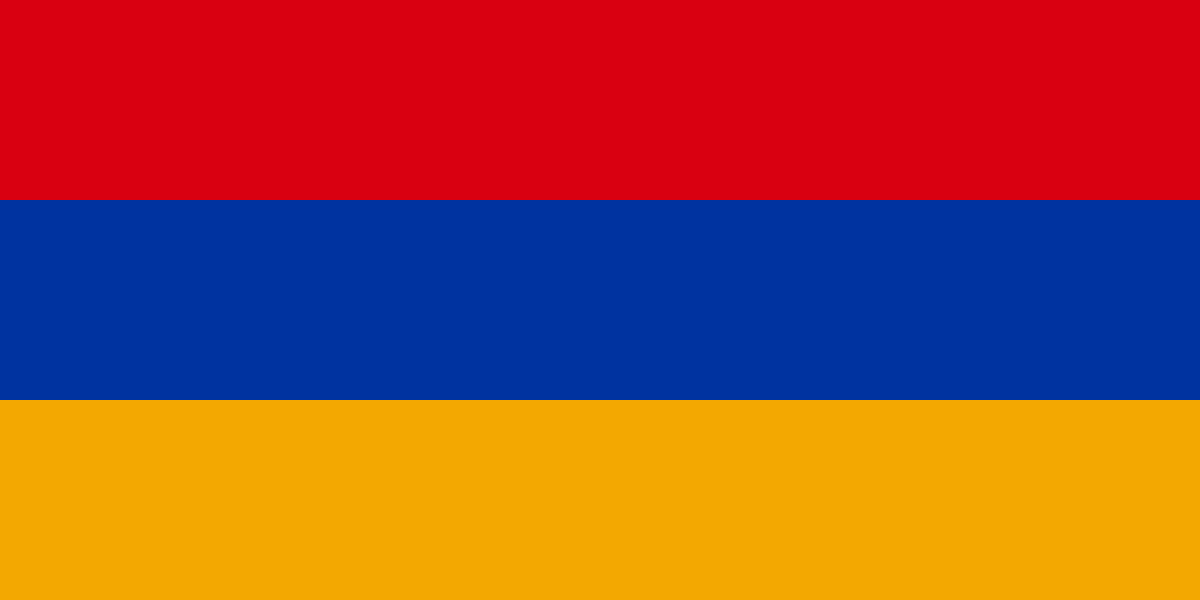
Armenia’s current national flag has three equal horizontal bands, red above blue above orange, on a rectangle twice as long as it is high. It carries no emblem.
Specification
Constitution article 21 establishes the equal horizontal tricolor. Flag Law HO-149-N, article 2, fixes the top-to-bottom order and 1:2 ratio.
Official color references
Decision 888-N, Annex 1, paragraphs 13–14, assigns Pantone and CMYK to printing, RGB to websites and television, and HTML colors to websites.
| Color | Pantone | CMYK (%) | RGB | HTML |
|---|---|---|---|---|
| Red | 485 | 0 / 100 / 100 / 0 | 217 / 0 / 18 | #D90012 |
| Blue | 286 | 100 / 80 / 0 / 0 | 0 / 51 / 160 | #0033A0 |
| Orange | 1235 | 0 / 35 / 100 / 0 | 242 / 168 / 0 | #F2A800 |
The table supplies no Pantone substrate suffix; none is inferred here. These are separately published references, not computed conversions. The SVG uses the official HTML values; a screen cannot certify printed or textile color.
Construction notes
For hoist H, set fly to 2H and divide the height into thirds. The specimen’s 1200 × 600 viewBox gives three visible 200-unit bands. Its three overlaid paths retain the Commons geometry and fills; only accessible metadata and a viewBox were added.
Decision 888-N, Annex 1, allows ±2% deviation in length and width and specifies fabric, colorfastness, seams and attachments. Those manufacturing requirements are separate from this ideal vector construction. Its Pantone substrate remains unspecified; consult the complete annex for physical production.
Color meanings
The Presidency’s explanation connects red with the Armenian Highland, survival, Christian faith, independence and freedom; blue with the desire for peaceful skies; and orange with creativity and industriousness.
Historical record
The Presidency dates adoption of the state-flag law to 24 August 1990. The present record covers the national flag from that adoption onward. A new flag law was adopted on 15 June 2006 following constitutional reform; ARLIS records signature on 4 July and commencement on 22 July 2006. This was a new legal framework, not a new band arrangement. The 2016 technical decision supplied manufacturing and color requirements.
Use and display
Flag Law article 3 requires display at specified public institutions and diplomatic premises and permits display on residential buildings. Article 7 requires a clean, intact, unfaded flag and illumination when permanently flown at night. For vertical hanging, rotate the flag 90° counterclockwise: the viewer sees red, blue and orange from left to right.
Source trail
Presidency: Constitution, article 21 ↗ — constitutional identity and equal bands.
Presidency: state symbols ↗ — adoption dates and meanings.
ARLIS: Flag Law HO-149-N, consolidated text effective 1 September 2026 ↗ — description, usage and commencement metadata.
ARLIS: Decision 888-N of 2 September 2016, Annex 1 ↗ — technical requirements and color table.
Commons: SVG code, contributors and public-domain declaration ↗ — specimen source; local asset register. Sources checked 14 September 2026.

Reading the color table
In the official color-reference table, CMYK percentages are ordered cyan, magenta, yellow and black. RGB means red, green and blue, with values listed in that order. HTML values are hexadecimal screen-color codes. The table’s official references are published separately, not calculated conversions from one color system to another. No Pantone substrate suffix is specified, so none is inferred. The specimen uses the official HTML values, but screen reproduction cannot certify printed or textile color.